Why the website now carries more weight in how customers understand products, evaluate expertise, and choose what fits their needs.
In this article
Over the past few months, through the IMIA webinar in February and conversations in London, one topic has come up repeatedly.
Most map businesses today sell through a mix of channels, distributors, retail, direct customers, and in many cases marketplaces like Amazon. That structure has not changed.
What has changed is the website’s central role in how customers understand and choose products. Customers use the website to understand what they are buying, compare options, and decide what fits their needs before placing an order through a distributor, retailer, or marketplace.
Because of this, the website’s role is shifting. It is no longer just a place to list products or process orders. It is where products are understood, where choices are made, and where the business itself is evaluated.
Where customers actually understand the product
Customers usually come to a map website with a clear purpose. They may be looking for a wall map, a classroom map, a business display map, or something for travel or planning. What they often need help with is understanding the options within that need.
A few practical questions come up quickly:
- What is the difference between a paper map, a laminated map, and a plastic finish?
- Which maps are better suited for display, and which are meant for regular use?
- Which products are more suitable for decor, education, or professional use?
- Can a map be customised, ordered in bulk, or adapted for a particular requirement?
A customer may start with a clear purpose, but the buying decision often depends on how well these choices are explained. The same map may suit more than one use, but it needs to be presented in the right context.
This is where the website matters. It is the ideal place to clearly explain these choices, show who a product is intended for, and help the customer choose the right option.
What your business is known for
Every map business has areas where it is stronger or better known.
For some, it may be outdoor and adventure maps. For others, decor and gifting. Some are known for educational products, while others are recognised for a particular publishing range or region.
This is usually understood internally. Customers, however, do not always see it clearly.
On most websites, these strengths appear as product categories. Outdoor maps, wall maps, educational maps, and so on. But categories group products, they do not explain what you are known for or how a customer should choose.
This is where the website can do more.
Instead of only listing products, these areas can be presented as pages that explain:
- what this part of your business is about
- who it is meant for
- how a customer should choose within it
For example, instead of just having a category called “Outdoor Maps”, the page could explain:
- what types of outdoor use these maps are suited for, such as hiking, cycling, or expedition planning
- what to look for, such as scale, durability, and level of detail
- which formats work better in the field
- and include curated selections based on real use, for example, maps suited for specific trails, regions, or types of terrain based on what actually works in those conditions
When this is done well, it builds far more credibility than a general product listing or a blog.
Once this is clear, the products under that section become easier to understand and select.
Why this matters more now
What has changed is not how customers compare products, but how information is interpreted and presented.
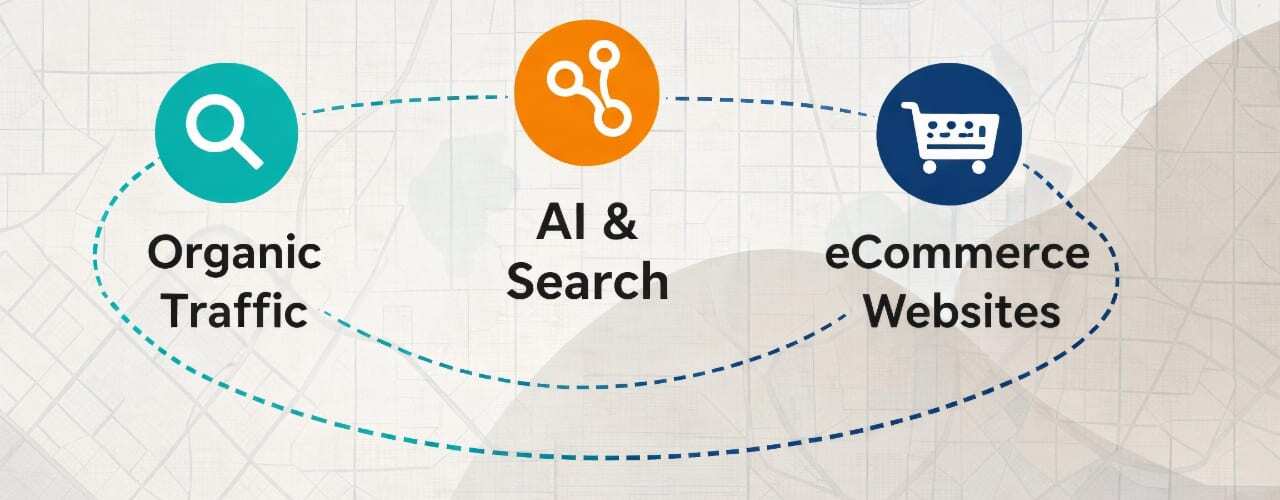
Search systems are now using AI to understand websites in terms of entities, intent, and context, not just keywords. At the same time, customers are using AI tools to explore options, ask questions, and narrow down choices.
In this environment, it is not enough to have products listed correctly.
Your website needs to clearly express what you are known for, how your products are used, and how a customer should choose between them.
When this is done well, your business is more likely to be understood correctly and presented in the right context, whether through search results or AI-driven summaries.
The website is not just where products are shown. It is where expertise becomes visible.
A quick test for your website
A simple way to look at your website is to step into the position of a first-time visitor.
A few questions to consider:
- Can someone quickly understand what your business is known for, without already knowing your brand?
- Is it clear which products are suited for different uses, such as decor, education, or professional work?
- If a customer has a specific need, can they easily see what options are relevant to them?
- Can a trade or B2B customer understand whether you handle bulk orders, custom requirements, or special requests?
- Do your main sections explain how to choose, or do they mainly list products?
- Does the website make it clear why someone should trust your expertise in this area?
If these answers are not clear, the issue is usually not the products themselves, but how they are presented and explained.
What this means for your website
Because of this, the role of the website needs to be looked at differently.
It is no longer just about building or maintaining an online store. The focus needs to shift towards how products are presented, how choices are explained, and how clearly the business is understood.
This means:
- making it clear what the business is known for
- helping customers choose between options, not just browse products
- structuring the website so that different needs and use cases are easy to understand
Less focus on adding more products or features, and more focus on making what already exists easier to understand and use.
A final thought
These are not large changes, but they do require a different way of looking at the website.
For many map businesses, the opportunity is not in adding more products or channels, but in making what already exists easier to understand, easier to navigate, and easier to choose from.
This is where we have been spending more time in our work, helping businesses bring more clarity to their websites so that they reflect both the products and the expertise behind them.